The 2026 Car Mandate: Does Your Steering Wheel Have the Right to Prosecute you?
The 2026 Car Mandate: Does Your Steering Wheel Have the Right to Prosecute you?
It will be a key milestone in 2026, as car technology and the privacy of the Internet of Things will change significantly. By the law of the 2021 Infrastructure Investment and Jobs Act, all new passenger cars produced after this year will come with sophisticated drunk driving passive prevention technology. Although this mandate is marketed as a safety revolution, it brings new complicated frontier in the area of DUI defense and constitutional law.
To the motorists, the issue is no longer a matter of failing to pass an edge of the road breathalyzer test; it is whether your personal automobile is constructing a case China against you since you got into the driver seat.
The Operational Process of Passive Detection.
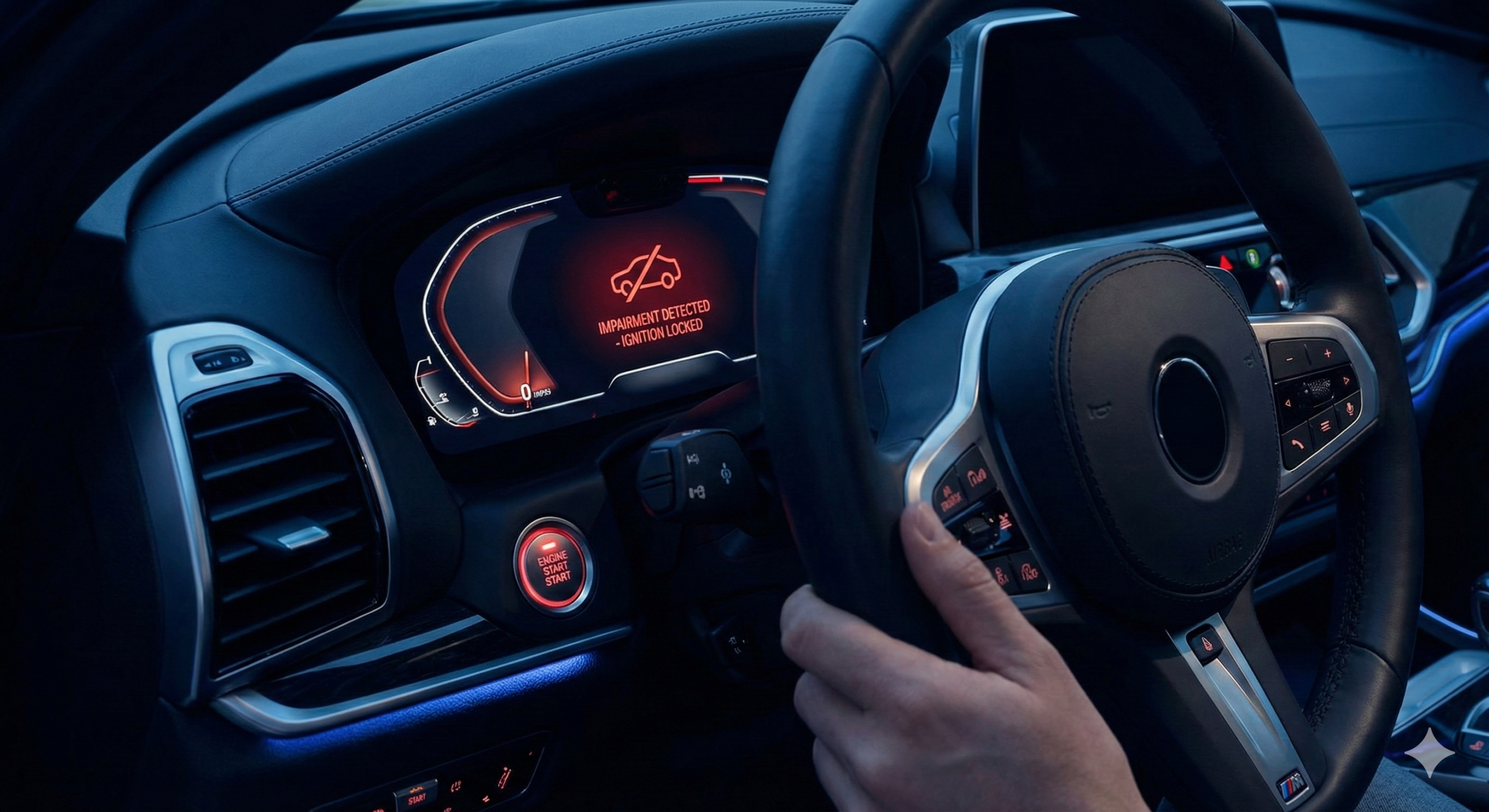
The passive systems of 2026 are got to be invisible as opposed to the previous huge ignition interlock devices (IIDs) which a driver needed to blow into a tube. Two main technologies are currently being introduced into the new car dashboards:
Infrared Breath Monitoring: Infrared-light sensors have been installed in the steering column or rearview mirror that scan the air inside the cabin. These sensors are able to tell the difference between the breath of a driver and a passenger and monitor the blood-alcohol concentration (BAC) in real-time.
Touch-Based Biometrics: Sensors located in the start button or within the skin of your steering wheel applies tissue-spectroscopy to detect the amount of alcohol under your skin.
When these sensors detect a BAC exceeding the legal limit (which is usually 0.08%), the car might refuse to start or in some designs the car might raise to a crawl or limit some of its driving capabilities.
The Issue of so-called Passive Accuracy.
Active testing being replaced with passive monitoring gives high allowance of error. According to conventional DUI stop, a breathalyzer should be used and giving certain measures to ensure that the sample of air is the deep lung air. Passive sensors on the other hand are vulnerable to environmental interference.
A false positive might be caused by high-alcohol hand sanitizer, mouthwash or some chemicals used to clean the inside of a cabin. Additionally, touch-based biometrics readings can be biased by biological differences in the skin thickness or temperature. James Yeargan has commented that with the adoption of the technologies, the problem of a driver being locked out of his or her own vehicle thanks to a technical malfunction, rather than drunk driving, is now a very tangible danger.
The Fourth Amendment In the Digital Age.
The gravest issue about the 2026 requirement is the legal aspect of the information that these cars would be gathering. In case your steering wheel feels impaired, this information is stored. This casts your Fourth Amendment right to unreasonable searches and seizures in critical question:
Is the Car a State Agent? Assuming that the government requires a privately owned company to put a device onto your vehicle that scans your breath or skin each time you get behind the wheel, the car is an extension of the police, is it?
Consent and Data ownership: are you essentially giving consent to allow your biometrics to be tracked by buying a new car? To whom do you qualify as the owner of the log of your BAC levels, to yourself or to the manufacturer?
Warrantless Seizures: When your car fails to start, because of a sensor reading, it is technically taking your property and you in it without a warrant or a human officer seeing a possible reason to do so, a probable cause.
Finding Your Way through the Future of DUI Defense.
With the advent of this era of the smart car the form of DUI litigation is transitioning to the new data forensics. To appeal a DUI in 2026, it is frequent to have to perform an in-depth search through the vehicle software logs, sensor calibration logs, and the actual conditions that existed when the detection occurred.
In the event that you have to contend with an accusation brought about by the passive monitoring system in your vehicle, it is necessary to know that these systems are not infallible. They are also machines and just as any machine, they are subject to failure or misreading information or they are prone to external factors.
James Yeargan is leading these technological changes to make sure that even as cars become smarter, your constitutional rights do not become any weaker. The highway might be altering, though the right to a proper and fair defense will never alter.

Recent Blog's

The 30 Day DDS Countdown: Why Your Timetable is Your Enemy After an Atlanta DUI
The 2026 Car Mandate: Does Your Steering Wheel Have the Right to Prosecute you?
Rental Car Nightmare: It Takes Two Troubles to Rent a Car in Atlanta at Turo or Hertz.
The Sleep It Off Trap: Do the Right Thing and Go To jail